To tell the whole story, we must go back to the spring of 2015. It was then that I first learned that a total solar eclipse was destined to pass over my home in Carbondale, IL on August 21st, 2017. Prior to that, and like many other kids growing up, my only experience with solar eclipses was trying to see a couple partial ones during school time. To accomplish this, the teacher would have us look through a hole cut into a shoe box. A second hole had also been cut that allowed us to see the shadow of the moon covering some of the sun – and the point of this contraption was to make it so we didn’t have to look straight up and go blind trying to witness this celestial event. Memory dictates this was a completely underwhelming experience each time I saw it, despite the fact I probably saw the celestial movements I was supposed to. I was of the Nintendo generation, and staring into a shoe box to see some light with a wedge cut out of it wasn’t nearly as engaging as Super Mario Bros. Still, the teachers’ attempts to enrich my young mind left enough of an impression that I can still visualize some semblance of at least one of those experiences.
For reasons I still don’t fully understand, that semblance served as a large glass of “Kool-Aid”, and I soon went down the eclipse rabbit hole. By summer I’d read everything on the internet I could find about total solar eclipses, which included learning we were being treated to a second one that was destined to pass overhead on April 8th, 2024. The probability of standing in one spot and having two total solar eclipses pass overhead seven years apart is incomprehensibly small – or as NASA put it, one in a billion.
Further adding to my fervor were the facts we were the point of longest duration of totality along the 2017 eclipse’s path (every second of totality counts), and we were the center point where both paths of totality crisscrossed. The exact middle point where the paths crossed, as calculated by NASA, was over Cedar Lake, about 10 miles south of Carbondale. Cedar Lake provides Carbondale with its drinking water, and a small part of me wants to believe that water is now cosmologically charged in some meaningful way.
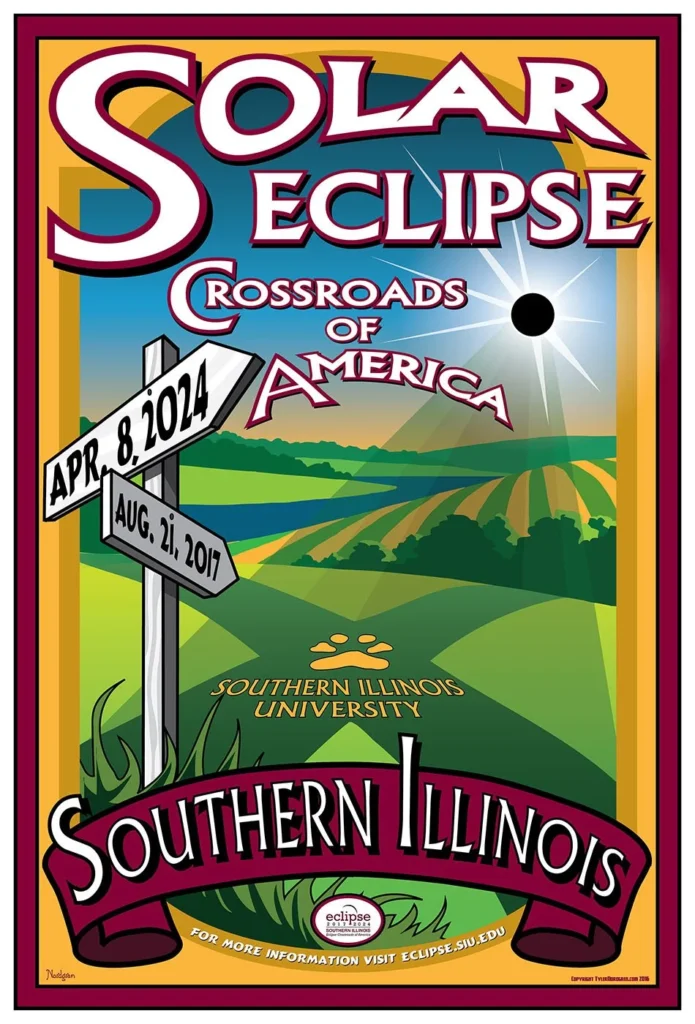
Fig. 1 The official poster celebrating Carbondale as the crossroads of the two great American eclipses.
The digital camera equipment I owned in 2017 was only so-so. In those days I defined being a “real” photographer as one who only used film. Despite my misguided snobbery, and my unwillingness to go all in with digital, I knew my so-so equipment was the best chance I had to get some decent shots of that eclipse because I had a 300mm zoom lens.
That first experience of totality, lasting a mere 2 minutes and 42 seconds, was one of those rare moments where the experience vastly surpassed the advertised 12/10 on the “WHOA” scale – it was more like a 15/10. Lending to my enthrallment was how cleverly totality left me wanting more. 2 minutes and 42 seconds is barely enough time for the viewer to stop pinching themselves to assure they are awake and realize what they are witnessing is real (see fig. 2 for additional drama that was added to the experience). I was hooked following that eclipse, and it was only 80 months until the next. For that one, I knew I’d be ready.
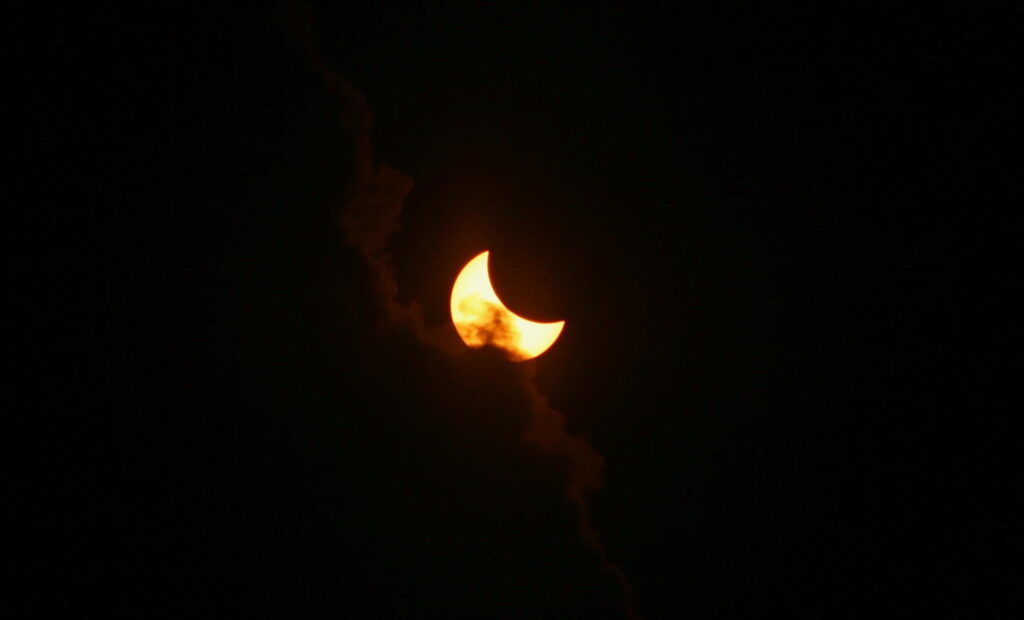
Fig. 2 Clouds added to the drama of the moment. There was a large cloud that moved overhead during the partial phase of the eclipse, which took a full 20 minutes to clear.
Luckily it passed a couple minutes before totality. The cloud then moved over Saluki stadium, a few miles to the east, and disrupted the show for the +10,000 viewers there.
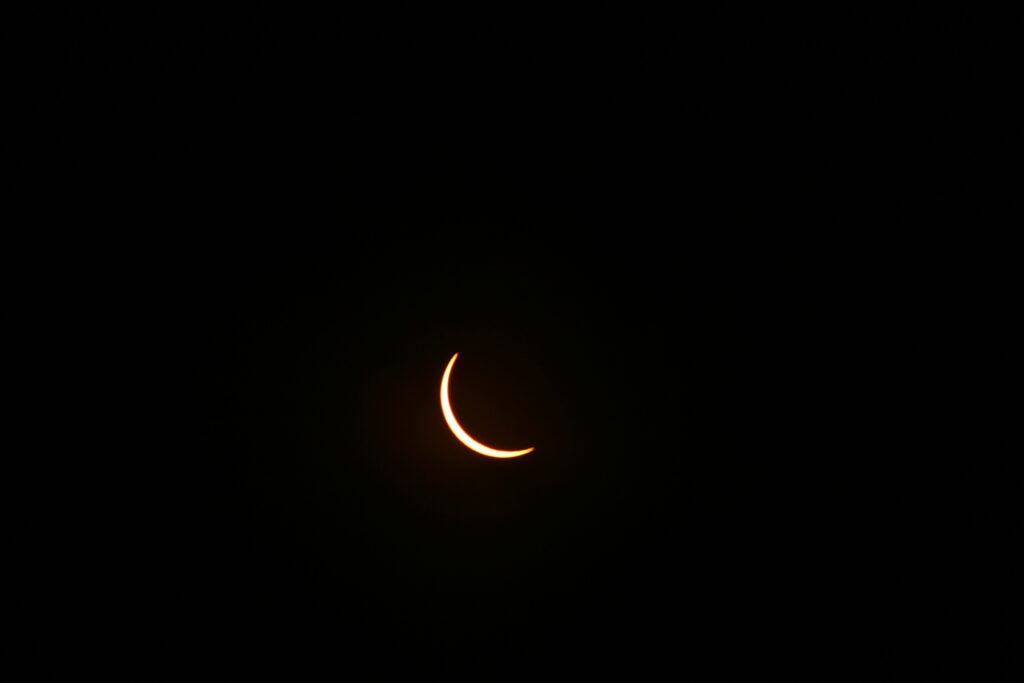
Fig. 3 The partial phase once the cloud cleared. A close call!
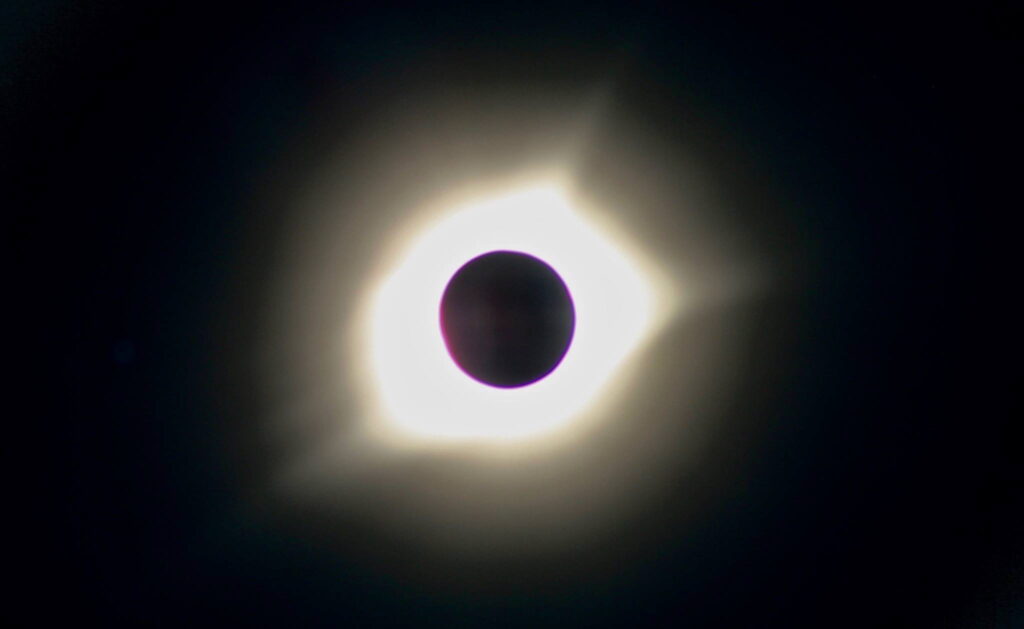
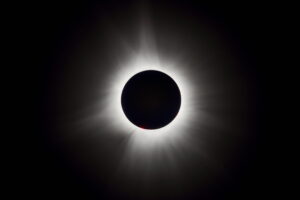
Fig. 4 A so-so photo of the glory unhinged a couple minutes later.
After seeing hordes of photographs x1000 better than my own following that first eclipse, one of the things I wanted to do during the second was to capture the black disc as part of a landscape shot. The trouble was my family wanted to stay home and watch it from our backyard, and there wasn’t much landscape potential there. Still, I thought there had to be a way to do something compelling. I pondered about it for some time, and a couple weeks before the second big show, an idea finally dawned on me.
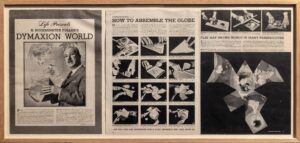
I had started to engage with the Fuller Dome Home board, and I was starting to get more into Bucky and his uniquely-shaped geodesic dome home. Given how much Bucky pondered the universe, and the peculiar appearance of his dome home, I thought getting a shot of totality above it was the way to go. Plus, an eclipse is the ultimate precession – a concept Bucky embraced dearly – an earth-dwelling mortal can experience. But I still had the problem of actually getting the shot, since I would be at home with my family. It wasn’t too long after thinking of the shot that I learned board member Ben Lowder was going to be staying at the dome and giving tours. This was my chance to make things work! I could set everything up beforehand, and he could trip the shutter in my absence. It is absolutely the case that a good photographer must be resourceful, and I fully understood the difficult logistics I had tasked for myself. Up to that point, I had never taken a picture while not being present (come to think of it, how many photographers have?).
Since I couldn’t be there in person, and I was photographing what was effectively a moving target, I spend a week before the eclipse figuring out where it was going to be in the sky. This also included going to the dome several times to figure out what focal length to use in order to squeeze everything I wanted into the frame. This was accomplished by going to the dome at the anticipated time of day when totality was expected (about 1:55 PM) to see the exact position of the sun in the sky. I had to use a solar filter to see how large the sun appeared in the frame, but the filter was too dark to see anything else (fig. 5). Removing the filter made it so the sun’s glare rendered it impossible to know precisely where the yellow orb was located. Since I couldn’t view both the orb of the sun and the dome together, composing my planned image was quite tricky.
Another challenge was working around the constraints caused by the fence just north of the dome’s driveway. This is because the shot had to be south facing (because of the position of the sun in the sky midday in April), and the fence limited how far back I could get from the north side of the dome to make everything fit into the scene. I had no choice but to use a wide-angle lens to make everything work, but, because of lens distortion, the wider the lens, the smaller the disc of the eclipse would appear in the final image. Another challenge was composing the shot days before the eclipse and then replicating that exact composition several hours before the eclipse on the day of. Altering the position of a wide-angle lens just a few inches is a sure-fire way to ruin the composition of such a shot – wide focal lengths are notoriously difficult to compose, especially when using a tripod. After much toiling, and trial and error, I settled on 22mm.
As a side note, it was lucky the position of the eclipse landed nicely within the composition I was basically stuck with. The shot wouldn’t have worked if the eclipse was positioned in the sky where the nearby trees that frame the final image blocked it.
The last challenge was figuring out my exposure triangle. I knew I wanted my ISO as low as possible, and I had to have enough depth of field to make everything tack sharp. The biggest question was how long to expose for? The eclipse exposure tables I found online helped some, but to be safe I also took test shots at the dome at dusk (fig. 6) a couple days before the eclipse. To help ensure good results, I set the final shot up as a bracketed set of 5 exposures – each at one stop increments. I also had the idea to turn the lights on to add a little detail and interest to what otherwise would have been a much darker, and less interesting, foreground. Ben enthusiastically agreed to trip the shutter, and I was as prepared as I could be for the big day.
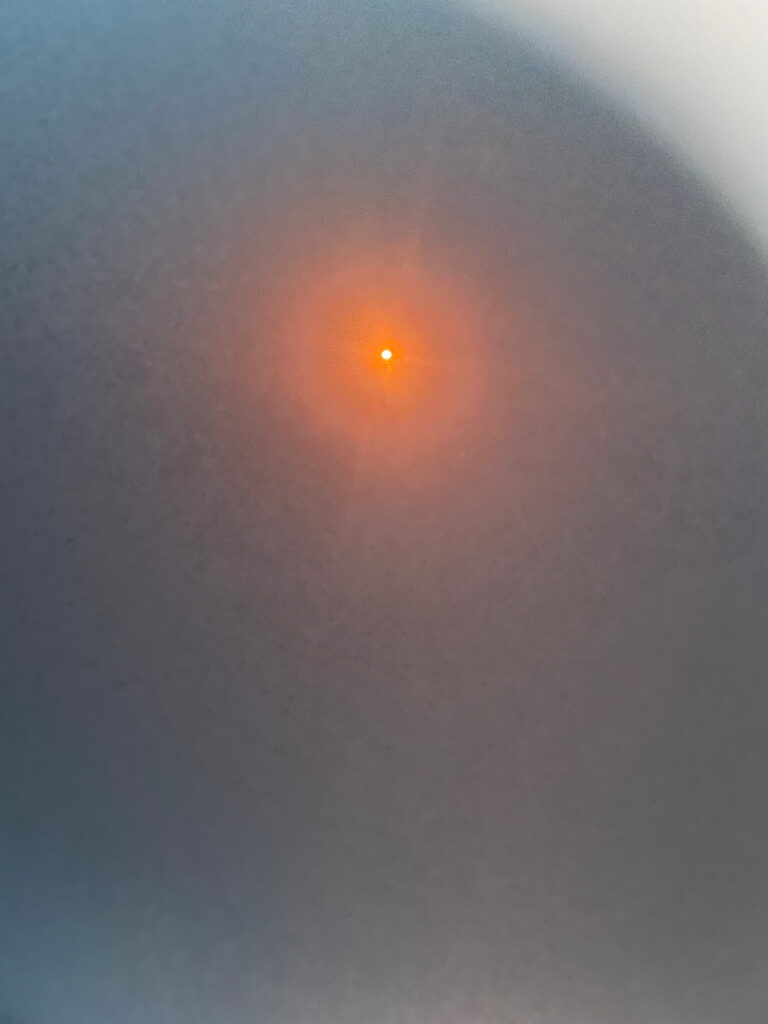
Fig. 5 One of the test shots trying to anticipate where in the sky the sun would be relative to my planned composition with the dome.
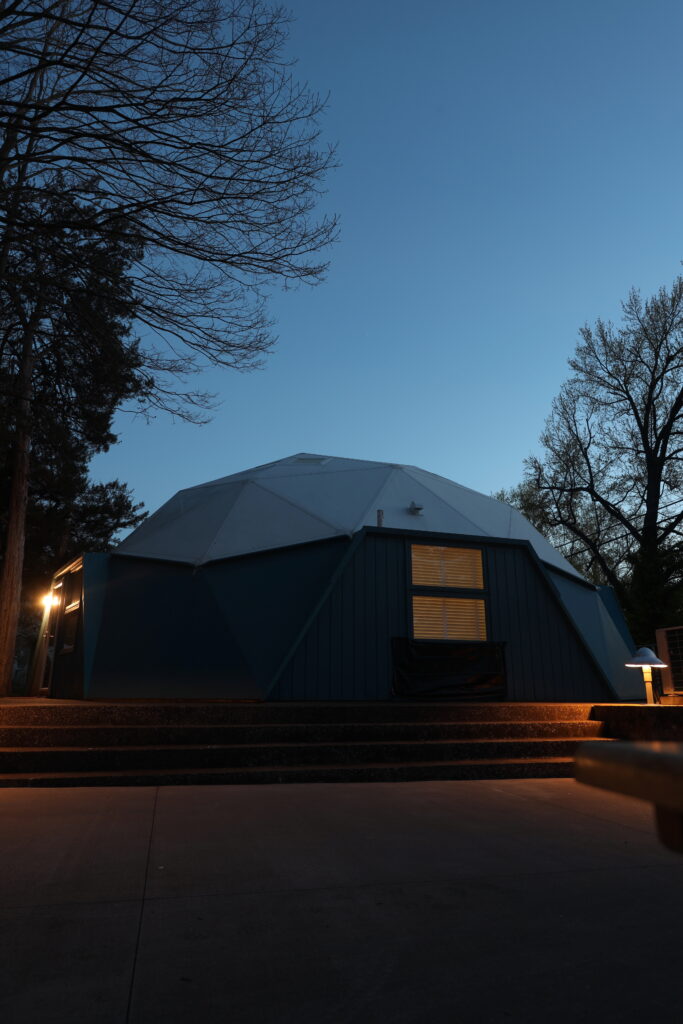
Fig. 6 One of my test shots at dusk trying to figure out the correct time for the exposure.
On the day of the second eclipse, I headed to the dome and set everything up a couple hours before the partial phase had begun. I had already set up my equipment in my backyard for my closeup shots. Following that second spectacular show, which lasted over 6 minutes in Carbondale, I eagerly headed to the dome to see what Ben had gotten. To my delight, all but the first few images looked usable. As fate would have it, I hadn’t angled the camera high enough (or the tripod ball sagged downward), and the first few shots excluded the disc of the eclipse. Ben realized this after taking the first few shots, and he pointed the camera up a bit. His quick thinking saved this once in forever capture (fig. 10).
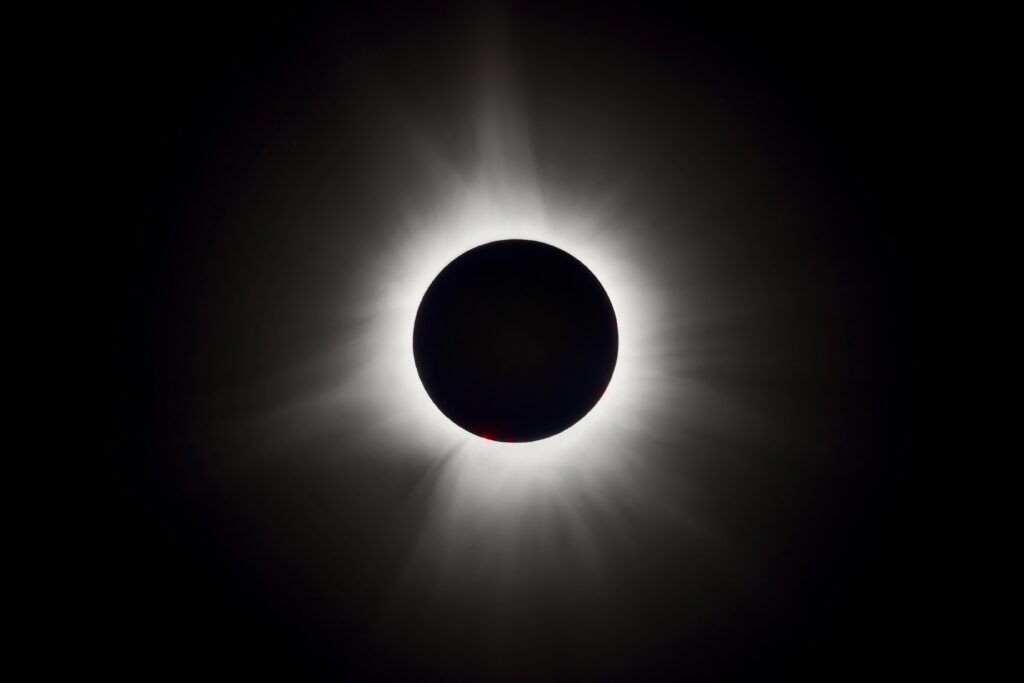
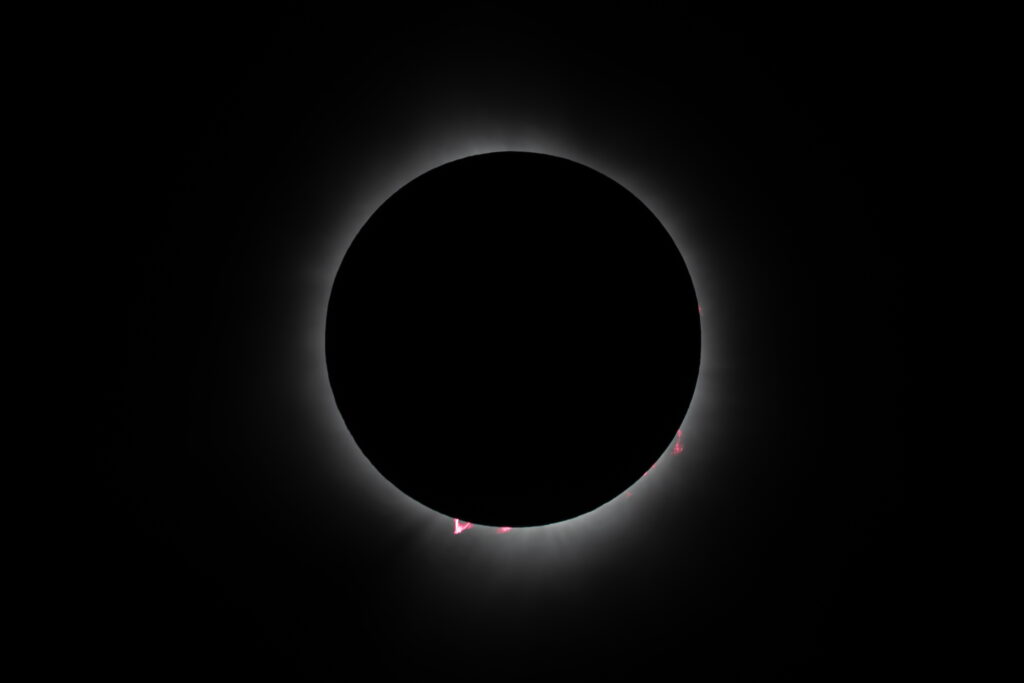
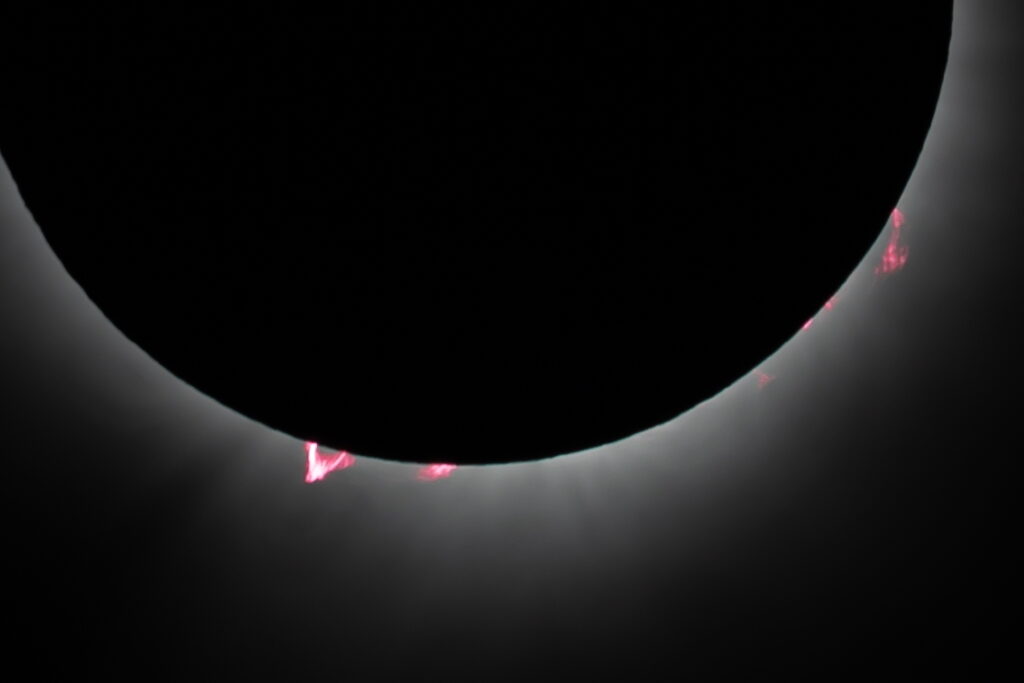
Figs. 7-9 Three of my best closeup shots taken from my backyard. By 2024 I had two proper digital cameras and a 600mm lens I used for these closeups. Everyone saw strange but beautiful pink laser lights twinkling from the disc during totality. Those pink lights confused us because they were absent during the 2017 show. A few minutes after totality had ended, and while reviewing my photos, I saw exactly what the twinkling was. Not long after that I learned they were solar prominences. The arch-shaped one was estimated to be several earths tall! What would Buck have thought of such a sight?
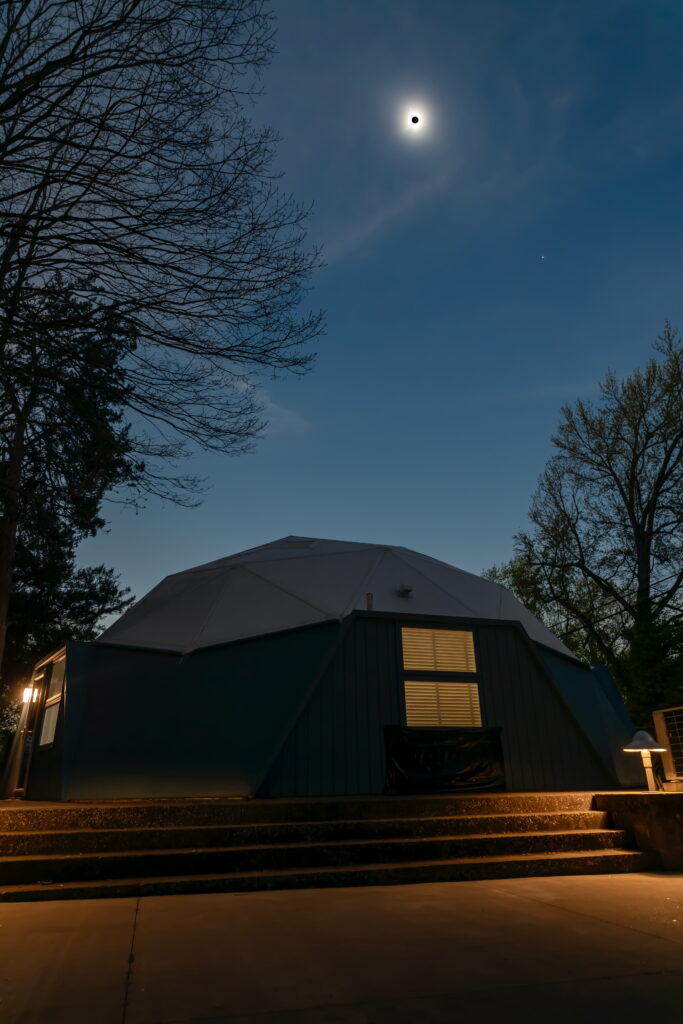
Fig. 10 My prize realized. The specs for this final shot were f7.1, 1.6 sec, 100 ISO, -2.3 EV, and 22mm. The large “star” below and to the right of the disc is Venus.
Going into this shot, I knew there would be a lot of symbolism that could be derived from such a magical moment. It took me around 18 months to finally start to put my feelings about its metaphorical implications into words. It also took that long for me to settle on a suitable title for the image – Sacred Geometries.
As mentioned above, Bucky speculated a lot about the structure of the universe. In particular, he understood there was a grand cosmic order that our physical universe operated under to keep in balance. He hypothesized the shape of the most basic quantum particle imaginable was the tetrahedron. He felt this way because of the tetrahedron’s inherent structural rigidity. Thanks to its strength, the tetrahedron is considered to be a sacred geometry. Also, thanks to its strength, the triangle (the 2D expression of the tetrahedron) is the shape responsible for making the geodesic design so robust.
On a grander scale, Bucky understood how gravity maintained the cosmic order on the macro level, by causing all matter to exist with tension binding it all together (effectively, the universe is one large Tensegrity model where the celestial bodies are the struts and gravity the cables. Celestial bodies never touch, yet they exist in a perfect balance, thanks to gravity). He also understood that gravity is responsible for precession. The cosmic precision required to allow solar eclipses to occur, from the perspective of a remote observer, as dictated by the balancing effects of gravity, is also considered a sacred geometry – but it is geometry in motion! This is all the essence of his concept of synergetics, and, from the perspective of life on earth, the moon perfectly covering the orb of the sun tangentially, and unexpectedly, allows us to see one of the most beautiful celestial phenomena – the corona of the sun. The cosmic geometry, precision, and precession that collectively allow for a total solar eclipse to pass over his geodesic-dome home is a physical manifestation of synergetics and his Tensegrity model of the universe. After all, synergetics was Bucky’s take on understanding the rules that govern the energy field we call the universe. What makes Sacred Geometries so special to me is that it single-handedly illustrates so many of his most important ideas in one photograph.
-Mike Chervinko